AI Ethics and the European AI Act

Navigating the EU’s proposed Artificial Intelligence Act: What Organisations Need to Know

The EU AI Act (the “AI Act”) is the world’s first comprehensive AI law. The Act lays down a harmonised legal framework for the development, supply, and use of AI products and services in the EU.  

To whom does the AI Act apply? 

The legal framework will apply to all AI systems impacting people in the EU, regardless of where systems are developed or deployed. 

When will the AI Act take effect? 

The AI Act is currently expected to enter into force in Q2-Q3 2024, with different obligations then taking effect in stages. 

Understanding the  AI Act’s Objectives 

The draft AI Act seeks to achieve a set of specific objectives:  

  • Ensuring that AI systems placed on the EU market are safe and respect existing EU law; 
  • Ensuring legal certainty to facilitate investment and innovation in AI; 
  • Enhancing governance and effective enforcement of EU law on fundamental rights and safety requirements applicable to AI systems; and  
  • Facilitating the development of a single market for lawful, safe, and trustworthy AI applications and preventing market fragmentation.  

AI Act: different rules for different risk levels 

The new rules establish obligations for providers and users depending on the level of risk from artificial intelligence. While many AI systems pose minimal risk, they need to be assessed. 

 
1. Unacceptable risk 

Unacceptable risk AI systems are systems considered a threat to people and will be banned.  

They include: 

  • Cognitive behavioural manipulation of people or specific vulnerable groups: for example, voice-activated toys that encourage dangerous behaviour in children. 
  • Social scoring: classifying people based on behaviour, socio-economic status, or personal characteristics. 
  • Biometric identification and categorisation of people. 
  • Real-time and remote biometric identification systems, such as facial recognition. 

Some exceptions may be allowed for law enforcement purposes. “Real-time” remote biometric identification systems will be allowed in a limited number of serious cases, while “post” remote biometric identification systems, where identification occurs after a significant delay, will be allowed to prosecute serious crimes and only after court approval. 

2. High risk 

AI systems that negatively affect safety or fundamental rights will be considered high risk and will be divided into two categories: 

1) AI systems that are used in products falling under the EU’s product safety legislation. This includes toys, aviation, cars, medical devices and lifts. 

2) AI systems falling into specific areas that will have to be registered in an EU database: 

  • Management and operation of critical infrastructure 
  • Education and vocational training 
  • Employment, worker management and access to self-employment 
  • Access to and enjoyment of essential private services and public services and benefits 
  • Law enforcement 
  • Migration, asylum and border control management 
  • Assistance in legal interpretation and application of the law. 

 
All high-risk AI systems will be assessed before being put on the market and also throughout their lifecycle. 

3. General purpose and generative AI 
Generative AI, like ChatGPT, would have to comply with transparency requirements: 

  • Disclosing that the content was generated by AI. 
  • Designing the model to prevent it from generating illegal content. 
  • Publishing summaries of copyrighted data used for training. 

High-impact general-purpose AI models that might pose systemic risk, such as the more advanced AI model GPT-4, would have to undergo thorough evaluations and any serious incidents would have to be reported to the European Commission. 

4. Limited risk 

Limited risk AI systems should comply with minimal transparency requirements that would allow users to make informed decisions. After interacting with the applications, the user can then decide whether they want to continue using it. Users should be made aware when they are interacting with AI. This includes AI systems that generate or manipulate image, audio or video content, for example deepfakes. 

Opportunities 

Ethical Leadership: Organisations that prioritise ethical AI practices and demonstrate a commitment to responsible innovation can enhance their reputation and build trust with consumers, employees, and regulators. By aligning with the principles of the AI Act, organisations can position themselves as leaders in ethical AI deployment. 

Innovation and Differentiation: The AI Act promotes regulatory sandboxes and real-world testing, providing opportunities for Organisations to innovate and develop AI solutions in a controlled environment. Companies that invest in compliance and develop AI systems that meet the  AI Act’s standards can differentiate themselves in the market and gain a competitive edge. 

Market Expansion: Compliance with the AI Act allows Organisations to access the European market with confidence, as they demonstrate adherence to regulatory requirements and respect for fundamental human rights. This opens opportunities for expansion and growth in a region that values ethical AI practices. 

Talent Acquisition: Companies that invest in talent acquisition and training to support AIA compliance with the AI Act can attract top-tier professionals with expertise in AI governance, ethics, and regulatory compliance. Building a skilled workforce capable of navigating the complexities of AI regulation is essential for long-term success. 

The AI Act represents a real opportunity for Organisations that are looking to leverage the power of AI. However, there are some threats that business leaders also need to consider. 

Threats: 

Compliance Costs: The AI Act imposes significant compliance costs on Organisations, including overhead expenses related to risk assessments, governance frameworks, and regulatory reporting. Companies that fail to allocate sufficient resources to the Act’s compliance may face financial strain and operational challenges. 

Fines and Penalties: Non-compliance with the AI Act can result in substantial fines ranging from €7.5 million to €35 million, or a percentage of global turnover. Organisations that neglect the AI Act’s requirements or underestimate the severity of regulatory violations risk facing severe financial penalties that could impact their bottom line and reputation. 

Operational Disruption: Implementing robust governance and oversight measures to ensure  compliance with the AI Act may require operational adjustments and process changes. Organisations that fail to adapt their operations to meet the AI Act’s standards may experience disruption and inefficiencies that hinder productivity and competitiveness. 

Reputational Damage: Violations of the AI Act’s ethical standards or failures to comply with regulatory requirements can lead to reputational damage and loss of consumer trust. Organisations that are perceived as prioritising profit over ethics or disregarding fundamental human rights may face backlash from stakeholders and damage to their brand reputation. 

Conclusion  

In conclusion, while the AI Act presents opportunities for Organisations to demonstrate ethical leadership, drive innovation, and access new markets, it also poses significant threats in terms of compliance costs, fines, operational disruption, and reputational damage. By proactively addressing these challenges and investing in compliance with the AI Act, Organisations can navigate the regulatory landscape successfully and leverage AI technologies responsibly for long-term growth and sustainability. 

For more comprehensive information on Calligo’s Data Ethics and Governance solutions, visit https://cal.essence-design.co.uk

For more information on Calligo’s AI solutions, visit https://www.calligo.io

Year in Review Video Title Slide Linkedin - 2MB Resize 02

Data Transformation Predictions for 2024 – Calligo Data Leaders Roundtable


In this lively debate you will hear from Calligo’s Practice Leads as they discuss their key takeaways from 2023 and their data predictions for 2024 and beyond.

Topics discussed include:

Regulation of AI including the EU AI act

AI hallucinations & AI bias

Data governance and data fines

Dashboard fatigue

Data ROI

Trends in Data Visualization Proliferation and Consolidation

Introduction 

When I started my first project with Microsoft back in 2019, I was tasked with creating a report to help a sales team understand when clients had licenses up for renewal and see detailed information about the client’s usage of licenses to help the sales team better optimize agreements with their customer base. The tool was revolutionary for the sales team, which used to pull data from several sources and spend hours making sure it was right. Reports done right can lead to huge efficiencies and make everyone’s jobs smoother, letting us focus on the decisions that truly matter. 

The problem 

With that project complete, I moved onto a new project with a different team, and then another. Two years later an email popped up from a random employee at Microsoft. He’d found the report I’d built and was asking if I could update it for him. I did a little digging and found that my old team had moved on to a new report, but the old one was still available in their portal and employees could still search for and find the report if they had the proper access. Reports and dashboards across the org had proliferated and no one was taking the time to consolidate them. As a result, people were finding old, not quite deprecated reports and trying to use outdated data to make decisions. 

The details 

This problem isn’t unique to Microsoft. If you’ve been working with data for long enough, this problem almost certainly applies to you. As people who love data, we want to see insights that are relevant to us and tailored specifically to the way we want to see the data. With multiple teams or levels viewing the same data, this can lead to custom reports for each group that all slice the data slightly differently. When metrics change, these changes don’t always make their way to every report, especially if Dave in accounting (sorry Dave!) created a copy of a report to do his own work. As time goes on, the number of reports keeps expanding and when new team members onboard they don’t know which reports have the right data. This can lead to muddy reporting environments, with reports from years ago that we keep around because we might want to see that data or that visual again someday. 

The Solution 

Are we doomed to drown in an unending deluge of reports or is there something we can do about it? 

  1. Create report documentation. 

Whenever you create a report, you should create documentation that outlines the data sources, the intended audience, and how the report is intended to be used. Documentation for a report overall should be supplemented by a data dictionary that covers the measures or calculations in the report and gives everyone clarity on what is being reported. We often add these as readme tabs or store them in a company wiki. This not only helps with keeping our environments clean, but also helps new users onboard. You will never have to answer the question – “What did we use this report for?” 

  1. Utilize report usage metrics. 

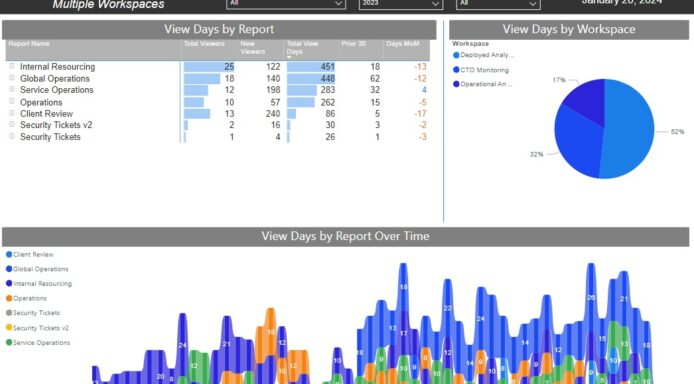
Power BI has built in reports that let you see which reports have been viewed and by whom. Tableau has similar features for Tableau server. We think these reports are so useful we built our own custom report that lets you see usage across workspaces or servers to help you make the decisions on what reports to deprecate. We deployed this in our own environments and for multiple customers.

Interact with the dashboard by clicking on the image below


  1. Archive reports offline. 

Sometimes we don’t want to get rid of reports or need to keep them, but we don’t want them to be available to the organization. In this case, we recommend creating an archive for reports to be kept offline or at least off the workspace or server. These reports should also have accompanying documentation and a data dictionary (thank you, readme tab!) 

Closing Remarks 

Maintaining your reporting environment hygiene pays dividends in the future and reduces confusion and wasted time. In fact, we saw this as one of our trends for 2023. Curious about the other trends we saw or our predictions about 2024? Watch our Data Transformation Predictions video to see them. We take our reporting work very seriously and our team has the tools and experience to help you with your environment.

For more comprehensive insights into data analytics and visualization, visit https://www.calligo.io

Machine learning as a service

What is Machine Learning as a Service and when should businesses consider using it?

In the rapidly evolving landscape of technology and data-driven decision-making, machine learning has emerged as a powerful tool to gain insights, optimize processes, and drive innovation. Machine learning, a subset of artificial intelligence, involves building models that can analyze data and make predictions. These models can unlock valuable insights and opportunities, making them a potent growth lever for organizations across various industries. However, despite its potential, machine learning is notoriously challenging to implement effectively without the right team of experts.

One company that has recognized the potential of machine learning and is offering a solution is Calligo. Calligo is a data optimization and privacy-focused company that provides a service known as Machine Learning as a Service (MLaaS). MLaaS is designed to help organizations harness the power of machine learning without the complexity and cost of building an in-house data science team or investing in expensive IT systems.

Benefits of Machine Learning as a Service

Machine Learning as a Service offers several key benefits for organizations looking to leverage the power of machine learning:

Improved Outcomes, Lower Costs, and Great Value

MLaaS is designed to bring about improved outcomes for businesses. By using machine learning models, organizations can make more informed decisions, optimize processes, and unlock new opportunities for growth. These improved outcomes often translate to lower costs and significant value for the business. It allows organizations to maximize their return on investment.

Minimal Outlay for Maximum Insight

One of the major advantages of MLaaS is that it allows organizations to access advanced machine learning capabilities without the need for significant upfront investments. This means you can get all the insight you need with minimal initial costs.

Massively Reduced Project Risk

Machine learning projects often come with inherent risks, including technical challenges, resource constraints, and the potential for unexpected roadblocks. MLaaS helps mitigate these risks by providing access to a specialized team of data science experts who can guide you through the entire process.

Access to a Full Data Science Operations Team

With MLaaS, organizations can essentially hire an entire end-to-end data science team without the complexities and expenses of traditional recruitment and the building of IT infrastructure. This means you can tap into a wealth of expertise and experience to drive your machine learning initiatives.

Time, Money, and Effort Savings

Implementing machine learning on your own can be time-consuming and costly. MLaaS streamlines the process, saving you both time and effort. With this service, you can focus on leveraging machine learning for your organization’s benefit instead of navigating the intricacies of implementation.

Cost Predictability

MLaaS offers a subscription-based model, so you have a clear understanding of costs and can avoid any unpleasant surprises. This cost predictability allows organizations to plan their budgets effectively.

Applications of Machine Learning for Businesses

Machine learning has a wide range of applications across different industries. Here are ten ways in which businesses can leverage machine learning to improve their operations and drive growth:

Predictive Maintenance

In industries where equipment and machinery play a critical role, machine learning can be used to predict when maintenance is required. By analyzing data from sensors and historical maintenance records, machine learning models can forecast when machinery is likely to fail, allowing organizations to perform maintenance tasks proactively, minimize downtime, and reduce maintenance costs.

Customer Segmentation

Machine learning can help businesses better understand their customers. By analyzing customer data, such as purchase history, behavior, and preferences, machine learning models can segment customers into distinct groups. This enables businesses to tailor marketing efforts and product recommendations to specific customer segments, ultimately improving customer satisfaction and increasing sales.

Fraud Detection

Machine learning is a powerful tool for identifying fraudulent activities. In the financial industry, for example, machine learning models can analyze transaction data to detect unusual patterns that may indicate fraudulent behavior. Businesses can use this technology to reduce financial losses and protect their customers from fraud.

Inventory Optimization

Optimizing inventory levels is crucial for businesses in retail, manufacturing, and distribution. Machine learning can help organizations forecast demand more accurately, leading to reduced excess inventory and stockouts. This, in turn, improves operational efficiency and reduces carrying costs.

Personalized Content Recommendations

Machine learning algorithms can analyze user behavior and preferences to deliver personalized content recommendations. This is commonly seen in streaming services like Netflix and music platforms like Spotify. By offering users content tailored to their interests, businesses can enhance user engagement and satisfaction.

Sentiment Analysis

Understanding customer sentiment is essential for businesses looking to improve their products and services. Machine learning can analyze social media, reviews, and customer feedback to gauge public sentiment. This analysis provides valuable insights for product development and reputation management.

Churn Prediction

Predicting customer churn is vital for businesses seeking to retain their customers. Machine learning models can analyze historical customer data to identify factors that contribute to churn. By recognizing the warning signs, businesses can take proactive measures to reduce churn and improve customer retention.

Demand Forecasting

Accurate demand forecasting is essential for businesses in the retail and supply chain sectors. Machine learning models can analyze historical sales data, seasonal patterns, and various other factors to provide more accurate demand forecasts. This allows businesses to optimize their inventory, reduce costs, and improve customer service.

Speech and Language Processing

Natural language processing (NLP) is a subfield of machine learning that focuses on the interaction between computers and human language. Businesses can use NLP to automate customer support, analyze customer interactions, and gain insights from textual data. This technology is particularly valuable for businesses with a strong online presence.

Risk Assessment

In the insurance and financial sectors, machine learning is employed to assess and underwrite risks more accurately. Machine learning models can analyze historical data and predict potential risks, helping organizations make informed decisions and improve the profitability of their portfolios.

Machine Learning as a Service from Calligo empowers organizations to implement these machine learning applications effectively and cost-efficiently, providing them with the tools and expertise they need to stay competitive in today’s data-driven world. Whether it’s predicting maintenance needs, optimizing inventory, or improving customer satisfaction, machine learning has the potential to transform the way businesses operate and grow.

Read more about how we can help with your machine learning needs here

AI and machine learning glossary

A glossary of AI terms and their meanings for business leaders

AI Adoption:

The process of integrating AI technologies into an organization’s existing workflows and systems.

AI Ethics:

The study and practice of ensuring that AI systems and technologies are developed and used in ways that are morally and socially responsible.

AI Expertise:

The development of in-house knowledge and capabilities related to AI, often through training and hiring AI professionals.

AI Governance:

The establishment of policies, regulations, and guidelines to govern the development and deployment of AI systems.

AI ROI (Return on Investment):

The measure of the value and benefits gained from AI investments compared to the costs incurred.

AI Strategy:

The development of a comprehensive plan for integrating AI into an organization’s operations and achieving specific business goals.

AI-Driven Automation:

The use of AI to automate repetitive tasks and processes, improving efficiency and reducing human labor.

AI-Enabled Personalization:

The application of AI to customize and tailor products, services, or content to individual user preferences.

AI-Powered Analytics:

The use of AI and ML to analyze large datasets and extract valuable insights for data-driven decision-making.

Algorithm:

A step-by-step set of instructions or rules for solving a specific problem or performing a task, used in AI and ML to process and analyze data.

Algorithmic Fairness:

The goal of designing AI systems and models to ensure they provide equitable and unbiased results, especially in sensitive domains like finance and hiring.

Artificial Intelligence (AI):

The field of computer science dedicated to creating systems and algorithms that can perform tasks that typically require human intelligence, such as problem-solving, learning, decision-making, and language understanding.

Bias:

Systematic errors or inaccuracies in AI and ML models that can lead to unfair or discriminatory outcomes, often stemming from biased training data.

Big Data:

Extremely large and complex datasets that require specialized techniques and technologies to store, process, and analyze effectively.

Chatbot:

An AI-powered software application that can simulate human conversation and assist with tasks like customer support and information retrieval.

Computer Vision:

The ability of machines to interpret and understand visual information from the world, such as images and videos, often used for tasks like object detection and facial recognition.

Data Science:

The interdisciplinary field that combines domain knowledge, statistics, and computer science to extract insights and knowledge from data.

Deep Learning Frameworks:

Libraries and platforms like TensorFlow and PyTorch that provide tools and resources for building and training deep neural networks.

Deep Learning:

A subfield of machine learning that utilizes neural networks with multiple layers (deep neural networks) to process and analyze complex data, often used for tasks like image and speech recognition.

Feature Engineering:

The process of selecting and transforming relevant variables or features from raw data to improve the performance of machine learning models.

Machine Learning (ML):

A subset of AI that involves the development of algorithms that allow computers to learn and make predictions or decisions based on data without being explicitly programmed.

Model Evaluation:

The process of assessing the performance and accuracy of AI or ML models using metrics like accuracy, precision, recall, and F1 score.

Natural Language Processing (NLP):

A field of AI that focuses on the interaction between computers and human language, enabling machines to understand, interpret, and generate human language.

Neural Network:

A computational model inspired by the structure and function of the human brain, composed of interconnected nodes (neurons) organized in layers to process information.

Overfitting:

A common issue in machine learning where a model is excessively tuned to the training data, leading to poor generalization on new, unseen data.

Reinforcement Learning:

A machine learning paradigm where agents learn to make decisions by interacting with an environment and receiving rewards or penalties based on their actions.

Supervised Learning Algorithm:

Algorithms used in supervised learning, such as linear regression, decision trees, and support vector machines.

Supervised Learning:

A type of machine learning where models are trained on labeled data, learning to make predictions or classifications based on input-output pairs.

Underfitting:

The opposite of overfitting, where a model is too simplistic to capture the underlying patterns in the data, resulting in low accuracy.

Unsupervised Learning:

A type of machine learning where models are trained on unlabeled data, seeking to identify patterns, clusters, or relationships within the data without specific guidance.

demystifying artificial intelligence

Navigating the AI Maze: Demystifying Artificial Intelligence and Its Misconceptions 

Foreword by Peter Matson, Machine Learning Solution Architect at Calligo

In the world of technology, few concepts have captured our collective imagination like Artificial Intelligence (AI). It’s the promise of machines that can think, learn, and perform tasks with a level of sophistication that mimics human intelligence. Yet, the allure of AI has also given rise to a web of confusion, myths, and misunderstandings.

At Calligo, we recognize that navigating the AI landscape can be akin to traversing a labyrinth—a journey fraught with complexity and riddled with misconceptions. As the Machine Learning Solution Architect at Calligo, I’ve seen firsthand the challenges that business leaders face in grasping the true potential of AI.

In this article, “Navigating the AI Maze: Demystifying Artificial Intelligence and Its Misconceptions,” we embark on a mission to bring clarity to the bewildering world of AI. Our aim is to equip you, the business leaders and decision-makers, with the knowledge needed to discern fact from fiction and to make informed choices regarding AI adoption.

Defining AI: Understanding the landscape

Artificial Intelligence (AI) has become a ubiquitous term in our modern world. From self-driving cars to personalized recommendation systems, AI has permeated nearly every aspect of our lives. In order to talk clearly about AI we need to have a shared definition of what we mean.

One such definition comes from John McCarthy, a professor of Computer Science at Stanford University who, in is his 2004 paper “What is Artificial Intelligence”, defined AI as “the science and engineering of making intelligent machines, especially intelligent computer programs. It is related to the similar task of using computers to understand human intelligence, but AI does not have to confine itself to methods that are biologically observable.”

This definition is useful and is used by many organizations including IBM. However, this is too general to cover the nuances of how AI has evolved over the last two decades. Microsoft has shifted from using a singular definition of AI to having several definitions that split the types of AI into meaningful categories: Narrow AI, General AI, and Artificial Super Intelligence (ASI).

Narrow AI is “the ability of a computer system to perform a narrowly defined task better than a human can.” This includes Machine Learning and is the type of AI we see in production today in autonomous vehicles, in Amazon and Netflix recommendations, and in Large-Language Models (LLMs) like ChatGPT.

General AI is “the ability of a computer system to outperform humans in any intellectual task.” This is the sort of AI we see in movies with super intelligence computers acting under their own agency. As of today, General AI is still theoretical. It remains to be seen if we can (or should) build General AI systems.

Artificial Super Intelligence is “a computer system that … [has] the ability to outperform humans in almost every field, including scientific creativity, general wisdom, and social skills.” This, like General AI, is theoretical.

As technology has advanced and AI applications have diversified, the definitions of AI have become more expansive and multifaceted, encompassing a wide spectrum of techniques and technologies that enable machines to perform tasks that were previously deemed uniquely human. This evolution of AI definitions has been driven by the emergence of various AI subfields, including machine learning, deep learning, natural language processing, computer vision, and more. These subfields have significantly contributed to the broadening of AI’s scope, making a clear definition of AI ever more important.

As you may have noticed, this list of definitions is not exhaustive. Many more definitions can be found in our glossary, which will help you to clarify and understand the landscape further. 

What About Machine Learning?

At the heart of AI’s capabilities lies machine learning, a subset of AI that has revolutionized the way computers process information. The origin of Machine Learning systems stemmed from research by neuroscientists into how humans think. The first model was built in 1952 by Arthur Samuel to play checkers and learn from each match to improve. This is important to note, as not all AI is machine learning. Where machine learning differentiates itself is that it is dynamic and able to make changes without direct human intervention.

This represented a significant departure from traditional rule-based systems. Instead of relying on rigid, pre-defined rules, machine learning algorithms have the capacity to learn and adapt from data. This adaptability makes them versatile and capable of handling complex tasks that were once exclusively within the domain of human intelligence.

Machine learning can be further categorized into several subfields, each with its unique characteristics and applications.

  • Supervised Learning: A type of machine learning where algorithms are trained on labeled data, where the correct answers are known. They learn to make predictions or classifications based on this labeled data and can include tasks like fraud detection, image recognition, or language translation.
  • Unsupervised Learning: A type of machine learning where algorithms learn from unlabeled data. These algorithms identify patterns, structures, or relationships within the data, often used in clustering and dimensionality reduction tasks.  
  • Reinforcement Learning: A type of machine learning that trains algorithms to make sequences of decisions to maximize a reward. It’s commonly used in applications like game playing and autonomous robotics.
  • Neural Network: A type of machine learning that mimics the way that humans think by creating a set of interconnected nodes or neurons. Neural networks excel in making decisions on non-linear and complex data and are often used for computer vision, natural language processing, speech recognition, and recommendation engines.
  • Deep Learning: An advanced type of machine learning that uses multiple layers of neural networks to simulate the behavior of the human brain. This requires large amounts of data and builds increasingly complex networks to find patterns and make predictions on data. It is commonly used in image recognition such as Apple’s Face ID and natural language processing.
  • Generative AI: A type of machine learning that is used to create new content, including images, sound, video, and data. It is designed to impersonate how humans create based on the set of data that is used to train it. We’ve seen an explosion of these types of models recently from companies like OpenAI with ChatGPT and DALL-E or Google’s Bard or Meta’s AudioCraft.

The Complications of Generative AI

All of these are examples of Narrow AI and are designed to handle a specific task or set of tasks. Some people will refer to Generative AI as Gen AI, which is also a term used for General AI. We have yet to develop General AI and we must use care when discussing AI and use the correct terminology.

Generative AI is relatively new to the field of AI and Machine Learning and has added complications to how we think and define AI. Despite how it may appear, Generative AI does not understand truth. It uses the same techniques as other machine learning models; it recognizes patterns in text and pairs that with data from the training set to make a prediction based on the set of data it was trained on. While this is quite impressive – it is not close to thinking and is not General AI.

Generative AI is built on unsupervised models where a clear objective cannot be defined. It uses deep learning and neural networks to identify patterns and structures within existing data to generate new and original content. Natural language processing and labeled data supplement the inputs to help refine what the output should look like. It’s important to note that the outputs aren’t fully original but are formed based on the training data to impersonate how humans create. This is why having DALL-E create a painting in the style of Van Gough works – the model is trained on his work or works of similar paintings that were tagged with expressionism or other related terms.

This can lead to some serious pitfalls if you try to apply generative AI to problems it was not built to solve and why transparency and accountability are critical to build trust. Generative AI is built on training data that has assumptions built into it which are not observable to the end user. Large language models (LLMs) like ChatGPT look for words that belong together and have learned the rules of the language they are trained in. They don’t understand the words they are using or the meanings behind them which can lead to what are called hallucinations – where a model will output a false result as if it were true. Additional guard rails must be built by the developers to protect against these cases.

With neural networks and by extension, Deep Learning and Generative AI, it is impossible to understand why a particular decision was made. Deep Learning models have millions of data points that are used to create a single decision. To test models, researchers will try a set of inputs and see what comes out of the model or analyze the training dataset, which may not be available to end users. This leads to complications that must be considered before implementing. While I can’t cover all of these issues in this blog, we talk more about them in our podcast, Beyond Data.

The Path to Informed Decision-Making

Clarity and understanding are the compasses we must wield while navigating the AI maze. AI literacy is not a luxury but a necessity for individuals, businesses, and policymakers. Informed choices are the bedrock of responsible AI adoption, ensuring that the benefits of AI are harnessed while mitigating risks.

As we venture into the future, AI is poised to become an even more integral part of our lives. Its potential to drive innovation, solve complex problems, and enhance human capabilities is boundless. However, with great power comes great responsibility. We must prioritize accountability, transparency, and ethical decision-making in AI development and deployment.

Ultimately, we must embrace the complex beauty of AI—a field that challenges our understanding of intelligence and offers solutions to some of humanity’s most pressing issues. Through AI, we can unlock new frontiers, empower individuals and organizations, and chart a course toward a future where technology serves as a force for good.

As we stand on the precipice of this AI-driven future, let us embark with clarity, responsibility, and a deep appreciation for the remarkable journey that is Navigating the AI Maze.

Machine Learning in Manufacturing

Top 9 Use Cases of Machine Learning in Manufacturing

The manufacturing industry is undergoing a significant transformation with the advancement of machine learning and artificial intelligence technologies. These advanced analytics capabilities enable manufacturers to gain valuable insights, optimize processes, reduce costs, and enhance overall operational efficiency. In this blog post, we will explore the top use cases of machine learning in the manufacturing industry, highlighting how Calligo’s Machine Learning as a Service capability can empower manufacturers to harness the power of data and make informed decisions.

1. Economic Shock Analysis

Machine learning can help manufacturers analyze the impact of sudden economic shocks on their capacity, product demand, and labor force. By leveraging macro-economic modeling, prediction models, and time-series analysis, Calligo’s solution enables companies to navigate uncertainties, reduce risks of decreased yield, supply loss, and idle labor costs, and optimize labor allocation. This empowers manufacturers to make profitable decisions even during challenging times.

2. Demand Forecasting

Accurate demand forecasting is crucial for manufacturers to optimize inventory levels, reduce costs, and improve customer satisfaction. Calligo’s machine learning solution leverages predictive models, external data sources, and time-series analysis to forecast future demand by geography. By incorporating multiple variables such as global economic environment, competitor actions, and changing customer preferences, manufacturers can meet demand, minimize inventory costs, and maximize revenue.

3. Supply and Demand Optimization

Machine learning helps manufacturers optimize product yield based on consumer demand and streamline logistics. By integrating information from logistics and consumer demand through time-series analysis and predictive modeling, Calligo enables manufacturers to ensure optimal product yield, minimize inventory costs, and enhance revenue while meeting customer expectations.

4. Supplier Degradation

Identifying suppliers and supplies that are degrading in quality is critical for operations and procurement. Through trend and time-series analysis, Calligo’s machine learning solution provides early warning indicators of sub-par materials, defects, or product failure. This empowers manufacturers to choose higher quality parts, negotiate better deals with suppliers, and enhance product quality while reducing costs.

5. Predictive Maintenance

Machine learning models can predict when and how in-line machines may fail, helping manufacturers reduce machine downtime, achieve yield targets, and lower labor costs. By leveraging predictive models and survival analysis, Calligo’s solution enables manufacturers to proactively plan maintenance activities, optimize logistics efforts, and enhance operational efficiency.

6. Inventory Optimization

Optimizing inventory levels while navigating competitive purchasing is a complex challenge. Calligo’s machine learning solution combines macro-economic modeling, optimization techniques, predictive models, and time-series analysis to provide customized inventory maintenance solutions. This helps manufacturers reduce storage costs, minimize lost sales, lower input costs, and increase efficiency.

7. Product Servicing Optimization

Efficient product servicing is crucial for profitability and customer satisfaction. Machine learning models, such as predictive models, Monte Carlo simulations, and optimization techniques, enable manufacturers to optimize product servicing activities, reduce repair costs, decrease labor costs, and enhance customer satisfaction by minimizing product downtime.

8. Logistics & Procurement Optimization

Machine learning enables manufacturers to organize and predict shipments, ensuring efficient supply and end-product delivery. By leveraging predictive models and time-series analysis, Calligo’s solution optimizes logistics efforts, reduces costs, improves production, enables quick product delivery, and enhances customer satisfaction.


Efficient procurement is critical for manufacturers to meet production needs, manage supply or demand issues, and reduce costs from inventory or lost sales. Calligo’s machine learning solution leverages predictive models and time-series analysis to understand and predict supply or demand issues, ensuring adequate supply to meet production needs while mitigating risks and increasing profitability.

9. Product Quality

Machine learning helps manufacturers improve product quality by identifying defects, failure patterns, and optimizing the production line. By utilizing predictive models and time-series analysis, Calligo’s solution enhances yield rates, reduces repair costs, streamlines labor allocation, and increases customer reliability.

The manufacturing industry stands to gain tremendous benefits from integrating machine learning into various processes. By harnessing Calligo’s Machine Learning as a Service capability, manufacturers can unlock valuable insights, optimize operations, reduce costs, and enhance overall efficiency. With applications ranging from economic shock analysis to procurement optimization, machine learning empowers manufacturers to make data-driven decisions, adapt to dynamic market conditions, and achieve long-term success in a competitive landscape.

Machine Learning in Non-Profit

Top 8 Use Cases of Machine Learning in the Non-Profit Industry

In the non-profit sector, organizations strive to make a meaningful impact on society. With the advent of machine learning, non-profits now have a powerful tool to leverage data and gain valuable insights to optimize their operations, enhance fundraising efforts, and deliver services more efficiently. In this blog post, we will explore the top use cases of machine learning in the non-profit industry, highlighting how Calligo’s Machine Learning as a Service capability can enable non-profit organizations to drive positive change and achieve their missions.

1. Value of Investments

Machine learning can help non-profit organizations accurately assess the value of their investments. By leveraging predictive models, time-series analysis, and economic modeling, Calligo’s solution enables non-profits to select future investments with a higher potential return. This empowers organizations to make data-driven decisions and secure their future impact. 

2. Impact of Marketing

Understanding the impact of marketing efforts is essential for non-profits to refine and allocate resources effectively. Calligo’s machine learning solution utilizes predictive models to analyze the impacts of concurrent marketing efforts, enabling organizations to identify the root causes of success and create conditions for successful marketing campaigns. 

3. Online Marketing

Machine learning enables non-profits to assess the impact of online marketing efforts and translate them into changes in revenue. Using Monte Carlo methods, prediction modeling, and collaborative filtering, Calligo’s solution predicts campaign responses and tailors messages to existing relationships or potential customers, driving increased engagement and support.

4. Which Donors to Pursue

Identifying the donors that non-profits should pursue for continued support is crucial for effective fundraising. Calligo’s machine learning solution applies clustering, customer segmentation, and collaborative filtering techniques to target the optimal group of potential donors, reducing marketing costs and increasing the response rate.

5. Pursuing New Markets

Machine learning assists non-profit organizations in identifying the most advantageous new markets to pursue. By utilizing predictive models and clustering techniques, Calligo’s solution incorporates data from new markets, employee resources, and organization-specific measurements of success to predict the impact and allocate resources efficiently. 

6. Fundraising Targets

Determining the best targets for fundraising efforts is a challenge for non-profits. Calligo’s machine learning solution, powered by predictive modeling, helps non-profit organizations assess the probability of outcomes for different fundraising efforts. This optimization enables non-profits to allocate resources efficiently and maximize their fundraising revenues. 

7. Labor Allocation

Efficiently allocating labor resources is crucial for non-profits to deliver products and services effectively. Calligo’s machine learning solution combines optimization and predictive modeling to optimize labor allocation based on task-specific and geographical factors, ensuring that the organization meets the needs of their beneficiaries. 

8. Storage and Shipping

Efficient storage and shipping are critical for non-profits, especially during humanitarian crises. Calligo’s machine learning solution utilizes predictive modeling and optimization techniques to suggest the most efficient routes, methods, and storage strategies, reducing costs and ensuring products are delivered economically and on time. 

Machine learning is revolutionizing the non-profit industry by empowering organizations to leverage data and make informed decisions that drive positive change. With Calligo’s Machine Learning as a Service capability, non-profit organizations can harness the power of machine learning to optimize investments, enhance marketing efforts, improve fundraising strategies, and deliver services more efficiently. By embracing these machine learning use cases, non-profits can maximize their impact and create a better future for the communities they serve.

Machine Learning in Retail

Top 10 Use Cases for Machine Learning in Retail

Machine learning is revolutionizing the retail industry by enabling data-driven decision-making, enhancing customer experiences, and optimizing operations. In this blog post, we will explore the top use cases of machine learning in retail, highlighting how Calligo’s Machine Learning as a Service capability empowers retailers to leverage the power of predictive models, clustering, time-series analysis, and optimization techniques.

1. Demand Forecasting

Accurate demand forecasting is crucial for optimizing inventory levels, reducing costs, and meeting customer expectations. Calligo’s predictive models, time-series analysis, and market segmentation enable retailers to predict demand based on regional characteristics, such as climate, culture, geography, and regulations. By aligning product selection with region-specific demand forecasts, retailers can enhance customer satisfaction, increase sales, and minimize losses from excess inventory. 

2. Data Anonymization

Retailers need to make full use of customer data while protecting privacy and complying with regulations. Our data masking and aggregation techniques ensure data anonymization, allowing retailers to maximize the value of customer data for targeted marketing and risk analysis while safeguarding sensitive information. By utilizing anonymized data, retailers can unlock revenue opportunities and mitigate the risks associated with data breaches. 

3. Customer Segmentation

Understanding customers and their preferences is essential for personalized marketing and product selection. Our clustering and collaborative filtering techniques enable retailers to segment customers based on various attributes, driving more effective marketing efforts and informing expansion plans. By leveraging machine learning algorithms, retailers gain valuable insights into customer behavior, enabling them to tailor their strategies and improve overall business performance. 

4. Sales Trends

Accurately predicting sales trends over time helps retailers optimize inventory, make informed product decisions, and plan for expansion or store closures. Calligo’s predictive models and time-series analysis analyze historical sales data, consumer preferences, seasonality, and macro-economic factors to identify underlying trends and project future sales. By leveraging these insights, retailers can adapt their strategies, optimize resources, and drive success. 

5. New Product Release

Launching a new product successfully requires understanding the demand and potential sales. Our predictive models, clustering, and time-series analysis enable retailers to predict demand for new products by comparing them to similar existing products. By leveraging historical sales data and consumer preferences, retailers can make informed decisions regarding inventory levels and mitigate losses from unsold products. 

6. Price Optimization

Determining the optimal price for products is critical for maximizing profitability and sales volume. Predictive models, optimization techniques, and A/B testing help retailers find the balance between gross margins and sales volume. By considering cost data, customer preferences, competitor pricing, and market dynamics, retailers can optimize pricing strategies, reduce excess inventory, and increase overall profitability. 

7. Store Location Optimization

Choosing the right locations for new stores and evaluating existing store performance is vital for retail success. Our clustering and market segmentation analysis leverage internal and external data to optimize store location selection based on specific business structures and revenue generation streams. By considering customer characteristics, local market data, and competition, retailers can drive revenue growth and minimize underperforming locations. 

8. Shelf-Space Optimization

Optimizing shelf space based on product demand is crucial for maximizing sales and overall store profitability. Our predictive models, optimization techniques, and time-series analysis help retailers determine the appropriate allocation of shelf space for products. By analyzing customer data, sales history, and location-specific factors, retailers can optimize product placement and improve overall store performance. 

9. Product Expansion

Identifying the right products for expansion and selecting the ideal store locations are key for retail growth. Our predictive models, clustering, and A/B testing enable retailers to match products with suitable retail locations, considering customer preferences and store dynamics. By leveraging machine learning algorithms, retailers can make data-driven decisions, optimize product expansion strategies, and reduce costs associated with unsold inventory. 

10. Product Lifecycle

Understanding the lifecycle of a product helps retailers make informed decisions about inventory management and stock replenishment. Calligo’s predictive models and time-series analysis analyze historical sales data, market dynamics, and customer preferences to determine the lifecycle of a product. By accurately tracking the rise and decline of product demand, retailers can optimize inventory levels and minimize losses from outdated or low-demand products. 

Machine learning is transforming the retail industry, enabling retailers to gain valuable insights from their data and make informed decisions. Calligo’s Machine Learning as a Service capability empowers retailers to leverage predictive models, clustering, time-series analysis, and optimization techniques to drive revenue growth, improve customer experiences, and optimize operations. By embracing machine learning, retailers can unlock new opportunities and stay ahead in a competitive market. 

Machine Learning in Financial Services

Top 8 Use Cases of Machine Learning in Financial Services

The financial services industry is undergoing a rapid transformation with the adoption of machine learning technologies. Machine learning enables financial institutions to leverage data and gain valuable insights to improve operational efficiency, enhance risk management, and deliver personalized experiences to customers. In this blog post, we will explore the top use cases of machine learning in the financial services industry, highlighting how Calligo’s Machine Learning as a Service capability can empower financial institutions to harness the power of data and drive positive outcomes. 

1. Fraud Detection

Detecting and preventing fraudulent activities is crucial for financial institutions to protect their customers and minimize revenue loss. Calligo’s machine learning solution leverages clustering, anomaly detection, and time-series analysis to quickly identify fraudulent transactions and loan applications. By stopping illegal activities in real-time, financial institutions can safeguard their customers’ data and maintain trust while reducing losses. 

2. Automated Data Extraction

Automating data collection from various sources and storing it in a structured manner enhances operational efficiency in financial services. Calligo’s machine learning solution utilizes optical character recognition (OCR), clustering, and natural language processing to automate data entry tasks. This not only reduces labor costs but also improves data accuracy by minimizing human errors. Financial institutions can access customer information faster, make informed decisions, and streamline processes. 

3. Customer Segmentation

Understanding customer behavior and preferences is crucial for financial institutions to offer personalized services and maximize profitability. Calligo’s machine learning solution applies clustering and collaborative filtering techniques to segment customers based on their characteristics. This enables institutions to tailor marketing efforts, select profitable product offerings, manage risks, and identify expansion opportunities effectively. 

4. Risk Assessment and Underwriting

Accurate risk assessment is fundamental for financial institutions to make informed decisions regarding financial products and economic scenarios. Calligo’s machine learning solution leverages predictive models and time-series analysis to assess risks associated with consumer credit quality, complex financial instruments, and market conditions. This helps institutions reduce the likelihood of financial loss, enhance revenue streams, and ensure more reliable outcomes. 

5. Return on Investments

Measuring the return on marketing investments and identifying successful marketing methods is essential for financial institutions to allocate resources effectively. Calligo’s machine learning solution utilizes predictive models, clustering, A/B testing, and customer segmentation to capture the best return from marketing efforts. This data-driven approach informs business strategies, focuses future marketing efforts, and maximizes revenue per customer. 

6. Product Recommendations

Providing personalized product recommendations to existing customers enhances customer satisfaction and generates additional revenue for financial institutions. Calligo’s machine learning solution combines predictive models, collaborative filtering, and time-series analysis to recommend products based on customer purchase history and behavior. This enables institutions to maximize the value and satisfaction of each customer, increasing cross-selling opportunities. 

7. Targeted Marketing

Targeting the right customers with new financial products is crucial for acquiring low-risk customers and minimizing marketing costs. Calligo’s machine learning solution leverages predictive models, collaborative filtering, and time-series analysis to identify the most suitable customers for new product offerings. This data-driven approach ensures efficient marketing efforts, increased revenue, and reduced potential losses. 

8. Data Anonymization

Protecting customer data while making full use of it is a top priority for financial institutions. Calligo’s machine learning solution implements data masking and aggregation techniques to anonymize data, enabling organizations to utilize or sell customer data while maintaining privacy and mitigating legal risks. Financial institutions can maximize the value of data, increase profitability, and ensure compliance with data privacy regulations. 

Machine learning is revolutionizing the financial services industry by enabling financial institutions to leverage data and make data-driven decisions across various areas of operation. With Calligo’s Machine Learning as a Service capability, financial institutions can harness the power of machine learning to detect fraud, automate data processes, understand customers, assess risks, optimize marketing efforts, and protect customer data. By embracing these use cases, financial institutions can stay ahead in a competitive landscape, enhance customer experiences, and drive positive outcomes. 

Machine Learning in Telecom

Top 5 Use Cases of Machine Learning in the Telecom Industry

Machine learning is revolutionizing the telecom industry by enabling data-driven decision-making, enhancing customer experiences, and optimizing operations. In this blog post, we will explore the top use cases of machine learning in telecom, highlighting how Calligo’s Machine Learning as a Service capability empowers telecom companies to leverage predictive models, optimization techniques, time-series analysis, and customer segmentation.

1. Optimize Call Center Staff

Efficient scheduling of call center staff is crucial for customer satisfaction and cost reduction. Calligo’s predictive models and optimization algorithms help telecom companies optimize call center staff scheduling based on call volumes and customer needs. By dynamically adjusting staff schedules, telecom companies can ensure efficient resource allocation, enhance customer experiences, and capture sales opportunities.

2. Market Penetration

Understanding market penetration and identifying high-potential markets are essential for telecom companies looking to expand their customer base. Calligo’s predictive models and time-series analysis help telecom companies assess market penetration and identify markets that offer the best return on investment. By leveraging data on customers, sales, and local market trends, telecom companies can focus their efforts on markets with high growth potential. 

3. Store Location Optimization

Selecting optimal locations for new retail stores is critical for maximizing revenue potential and minimizing building costs. Calligo’s machine learning solutions analyze data on network capacity, finance, customer demographics, and market trends to identify the best locations for new telecom stores. By optimizing store locations, telecom companies can capture new customers, increase market share, and ensure the best network coverage for their customers.

4. Service Interruption Detection

Predicting and quickly responding to network problems is vital for maintaining revenue, customer retention, and satisfaction. Calligo’s predictive models, time-series analysis, and anomaly detection techniques enable telecom companies to detect and respond to service interruptions proactively. By identifying network anomalies and implementing efficient troubleshooting and repair strategies, telecom companies can minimize downtime and ensure uninterrupted service for their customers. 

5. Customer Segmentation

Understanding current and potential customers is crucial for targeted marketing and sales decisions. Calligo’s clustering and collaborative filtering techniques help telecom companies segment their customer base based on various attributes such as usage patterns, demographics, and preferences. By leveraging machine learning algorithms, telecom companies gain insights into customer behavior and preferences, enabling them to tailor marketing efforts, offer personalized services, and drive revenue growth.

Machine learning is transforming the telecom industry, enabling telecom companies to leverage data-driven insights and make informed decisions. Calligo’s Machine Learning as a Service capability empowers telecom companies to optimize call center operations, improve market penetration, optimize store locations, detect service interruptions, and understand customer segments. By embracing machine learning, telecom companies can enhance customer experiences, drive revenue growth, and stay ahead in a competitive market.

lie machines

Lie Machines – The global fight against misinformation

Exorcizing the ghost in the machine

In this latest podcast in our ‘Beyond Data’ series, Tessa Jones (Calligo’s Chief Data Scientist) and Peter Matson (Data Science Practice Lead) talk with Oxford University’s Professor Philip Howard about the threats posed to democracy by technology, specifically in the shape of Lie Machines.

Fact or fiction? Microtargeting with lie machines

In this age of social media, chatbots and AI it’s never been easier for individuals to share their opinions.  Instant communication to, and engagement with, a global audience is now commonplace, and it seems there’s no need to let facts get in the way of a good angle. As Mark Twain, or maybe Winston Churchill, or most probably Jonathan Swift famously said, “a lie can travel halfway around the world whilst the truth is still putting on its shoes.” A great example in itself of the ease in which misunderstandings and misappropriations can become canon.

In this vein, Professor Howard has spent years studying the mechanisms in which opinion, behavior and values can be manipulated and misdirected by lie machines:

“Lie machines are large, complex mechanisms made up of people, organizations, and social media algorithms that generate theories to fit a few facts, while leaving you with a crazy

conclusion easily undermined by accurate information. By manipulating data and algorithms in the service of a political agenda, the best lie machines generate false explanations that

seem to fit the facts.”

Lie Machines: How to Save Democracy from Troll Armies, Deceitful Robots, Junk News Operations, and Political Operatives

We find lie machines in all types of countries and governing structures. They share common elements – political actors produce the lies, social media firms distribute them, and paid consultants market them. High profile examples of the effectiveness of the lie machine include the UK’s Brexit campaign, and Trump’s electioneering – in both cases patently untrue ‘facts’ and arguments were targeted at key voters by disinformation networks, troll farms and lie machines. Algorithms direct individuals towards ever-more insular sources and extreme content:

 “A healthy, public-facing algorithm might occasionally introduce another credible source…  we know the platforms play around with this stuff, especially during elections in the US”

Controlled by bad actors and forming a global ecosystem of lie development and propagation, these lie machines spread their tendrils across every social media platform, moving out from Facebook as new outlets develop.

Computational propaganda

Lie machines have evolved and finessed themselves as technology advances. Instead of stealing the photos, social media handles and biographies of real people, AI now generates new pictures and personas and thus evades technology platforms’ troll-spotting software.

Spreading propaganda far and wide, with a convincing voice, the lie machine

  • Has a profound effect on society, with a scale that is difficult to quantify
  • Is perfectly engineered to target human vulnerabilities, reducing critical thinking
  • Deliberately misrepresents and appeals to emotions and prejudices, using our cognitive biases to bypass rational thought and create echo chambers
  • Is vague and unknowable – what training data was used for large language models? (Professor Howard postulates that every Gmail sent over the last 25 years may have been scraped, along with content from junk news sites)

Doing better – where does the onus sit? User or developer?

When it comes to developing processes to combat the lie machine, there’s no one legislation or guiding principle that works. We must always consider the regional and cultural context of both data and users. Research can’t necessarily be amalgamated or directly compared from different regions and countries – for example, we know that the placebo effect is always greater in US medical studies. To date, technology has not always built in cultural nuances in how people use words, with intent and meaning lost in translation – the majority of network takedown orders are for sites that are not in English.

Wherever there is human input, there are behavioral differences that make it much more difficult to apply common rules:

“People who manage cookies are above average in terms of their knowledge of technology, so these people are generally more purposeful in terms of how they set up their news feeds and where they go for information”

The huge amount of disinformation spread around Covid and the resulting vaccination campaign demonstrates how potent the lie machine is. It doesn’t need to convince people its argument is right, all that is required is to introduce enough doubt, to highlight there is a chance of harm. After all:

“If everybody really understood probability, nobody would ever buy a lottery ticket”

Balance the field – breaking the lie machines

Professor Howard believes that whilst we are justified in our concern about the threats to democracy, the principles behind the lie machine can be harnessed for good – promoting topics that are in the public interest and generating democratic discourse:

“I am cynical, but not fatalistic”

He describes the steps we can take to break the lie machines:

  • Public policy oversight, founded in ongoing public data capture and analysis
  • Designing social media to highlight emerging consensus, rather than heated conflict – machine learning can amplify common ground
  • Setting election guidelines to create more opportunities for civic expression
  • Giving journalists, civic groups and researchers access to all the public opinion data that is currently in the hands of the technology firms
  • Ensuring that the big data collected by technology platforms is added to public archives

The answer is more social media, not less. But it needs to serve society much better.

IPIE – bringing down the lie machine

Professor Howard has recently launched a new program, creating an independent scientific body to foster global cooperation in safeguarding the online information environment. The International Panel for the Information Environment (IPIE) will assess the scope of the misinformation crisis, analyze its effects on our societies and the planet itself, and propose solutions. Featuring data scientists and engineers alongside neuroscientists and sociologists, IPIE hopes to be the beginning of a global effort to save our common information environment.

Watch the podcast for yourself below to hear more from Professor Philip Howard about the power of the lie machine, and crucially, to learn how we can use it for the collective good.

Professor Philip Howard is a social scientist with expertise in technology, public policy and international affairs. He is Director of Oxford University’s Programme on Democracy and Technology, a Statutory Professor at Balliol College, and he is affiliated with the Departments of Politics and Sociology. Currently, he is also a Visiting Fellow at the Carr Center for Human Rights at Harvard University’s Kennedy School.