Tag: data insights

Art + Data eBook - data visualization

Art + Data ebook

The importance of data visualization is simple; it helps people visualize, engage with, and better understand data. Powerful data storytelling can:

• Give your data an accurate context
• Make it readily intelligible, comprehensible and interrogable
• Free your data, putting it in the hands of the users who need it

Get these right and you turn data from being latent and underused into a genuine asset that can redefine your performance,
objectives and strategy. This is what this book aims to show.

These visualizations are examples of how raw data sources can be transformed into data stories. They show how even the most functional business operations, or the most complex, dense and changeable datasets can be presented attractively and usefully.

We hope that these 20 examples will inspire you to what could – and should – be possible with your data.


Cloud and data separately

Security SOS: It’s dangerous to view cloud and data separately

Security risks within the IT infrastructure of global businesses are increasingly prevalent – and damaging. When swathes of data are separated in the hybrid or multi cloud, it can leave big open doorways for malware to walk right in.

The message I want businesses to hear is that cloud and data are not separate. IT only exists to service the needs of a business’ data. Securing cloud services – and therefore your data – is a business-critical issue.

Read on to understand:

  1. The limitations of AV
  2. The dangers of remote networks
  3. The cost of getting security wrong

1. Blind faith in AV

Businesses are too often putting their faith in antivirus (AV) software. This is unintentional blind faith, in my opinion. The problem with AV software alone is that it does not go far enough to protect businesses data assets; it only detects known threats and is not reliable against new variants. We speak to a lot of businesses that assume their security box is ticked, thanks to AV software alone.

But what about zero-day attacks that make up most data breaches these days? A zero-day vulnerability is a computer security vulnerability unknown by anti-virus software creators; they’ve had ‘0’ days to work on a security patch or an update to fix the issue. Zero-day attacks leverage innovative multi-layered approaches – like BitLocker encryption – that haven’t been seen before; anomalies that business software can’t easily detect and protect against without human intervention.

The need to have human and AI based security operations centers (SOC) is increasing, but the cost to implement internally is high and the skills are in short supply. This can cause complications when trying to get pay-outs from cyber security insurers – because businesses haven’t invested in a higher level of threat protection.

Against this backdrop, AV is like wearing chain mail with a gaping hole in the front.

2. Leaving doors open in our remote working world

Unsurprisingly, zero-day vulnerability is greater in our remote working world. Weaker control systems, attacks on remote working infrastructure, sensitive data accessed through unsecured Wi-Fi networks, expanded attack surfaces, the use of personal devices…The list goes on. SaaS in one corner, Office 365 and Dynamic CRM in the other. Servers, software and data – here, there and everywhere. Not to mention outdated legacy operating systems.

Businesses have previously relied on remote access virtual private networks (VPN) for users – but this creates a tunnel between devices and company networks that’s hard to secure adequately. It also means a laptop or personal device can easily become a conduit. A virus or malware can scan for open communication channels – and find its way easily into a corporate environment. If your business IT environment has modern applications, your security must also be modernised. And fast.

This is where Zero Trust Network Access can come into play to secure access to internal applications for remote users. ZTNA gives remote users connectivity to private apps without placing them on external network tunnels or exposing the apps directly to the internet.

It’s about changing the architecture to be as secure as possible for the modern way we work.

3. The financial – and reputational – costs

Under British data protection laws, for example, a company could also face a fine of up to 4% of its global turnover if it is found to have failed to have met its data protection duties by the Information Commissioner’s Office (ICO). This is not new news. But despite the serious risk this poses to a business, many organisations still have an ‘it won’t happen to me’ attitude.

Zero-day attacks – or any type of data breach – can be hugely costly for a company. We know, because we we’ve had big business customers who’ve been in this predicament (not on our watch, I hasten to add!). Add into the mix GDPR – and uninformed reliance on AV and cyber insurance and a lack of control over remote networks has landed many in trouble with the regulators. Hefty fines – and reputational damage.

Businesses that value their data need to value security, first and foremost. And that starts in the cloud.

how intelligent are AI tea-making robots

How intelligent are AI tea-making robots?

When it comes to how truly intelligent Artificial Intelligence (AI) is, it’s a polarizing debate. Either AI will solve the world’s woes or robots will rule us all – Matrix-style. But it’s all a little more complicated than Hollywood makes it seem…

Watch podcast episode 2 here

For a deep dive, do listen to our Beyond the Data podcast hosted by Sophie Chase-Borthwick (Calligo’s Global Data & Governance Lead) and Tessa Jones (VP of Data Science Research & Development).

Meanwhile, in this blog we look at tea-making and social care robots to illustrate an otherwise very nuanced and arguably never-ending narrative on the ‘intelligence’ part of the AI equation.

It’s important first to consider the different types of AI:

  • The majority of AI is ‘narrow AI’ – a single task, building a system to perform a particular task. You can build lots of narrow AI systems to perform together.
  • General AI, in comparison, is a lot more broad – intelligent machines that can learn, perform, and comprehend intellectual tasks much like a human. This is the territory where it’s a lot less clear-cut.

Let’s unpick the gray area of ‘general AI’, by looking at what robots are capable of – and whether this makes them truly intelligent, yet…

Tea-making as a success criteria for intelligence?

A robot making a cup of tea isn’t something a lot of us think twice about and wouldn’t be the first example of proving intelligence in a typical setting. However, scientists are doing just this, typically by:
1. Coding in the tasks a robot has to complete first (boil kettle, get cup, put the teabag in and so on).

2. Using experience-based learning to demonstrate how to make a cup of tea. When the robot doesn’t do it well or something is not done correctly, then the robot is given more examples of how to do that task.

To successfully have the robot make a cup of tea, scientists are having to build in and prescribe a lot of the parameters and tasks a robot has to complete. However, if the environment changes (for example a robot has to make a cup of tea in a different room) it would likely struggle because it isn’t familiar with the environment and the parameters.

Intelligence can’t just be about managing to do a task correctly; it’s being able to use inference to adapt in a new environment and navigate unfamiliar parameters to complete a task.

However, this adaptation and re-learning is a lot slower for robots than it is for humans. As Tessa Jones highlights, it’s referred to as Moravec’s paradox and essentially means it’s easy to train robots to do things that humans find hard, like chess and logic-driven tasks. However, it’s hard to train robots to do things humans find easy, like walking and image recognition.

In the podcast Sophie Chase-Borthwick observes: “Playing a game of chess is very rule-based [and easy to code into a robot] whereas making a decent cup of tea is definitely an art”.

Using a Japanese concept to make robots more human

This image has an empty alt attribute; its file name is MicrosoftTeams-image-111-2-1024x576.png

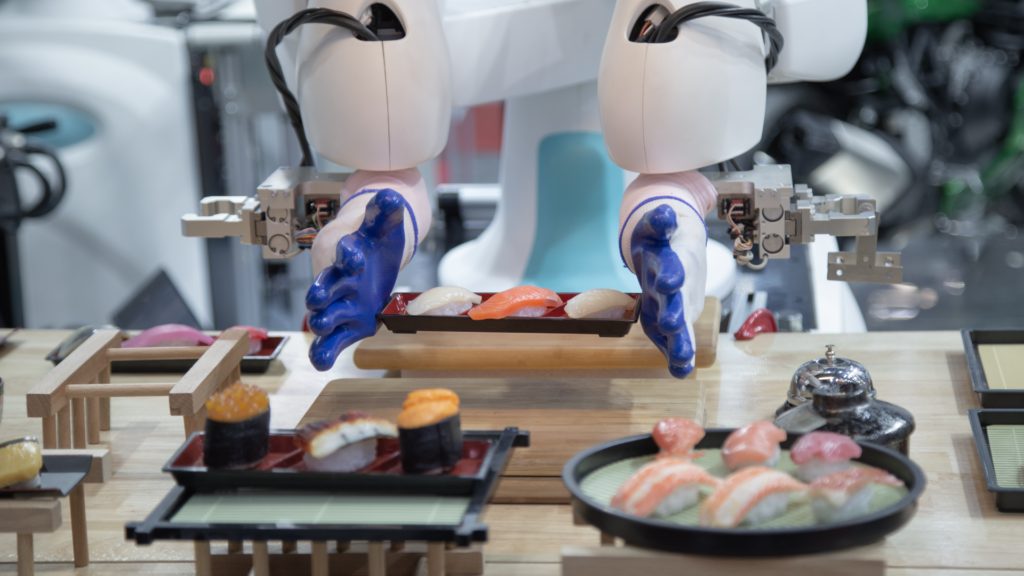
When looking at robots comprehending tasks much like a human, what could be more human than caring for one another? Japan is leading the exploration of the use of social robotics for assisted care. However, rather than the robot just serving a functional task, Japanese scientists are building one step further…

“There’s a concept coming out of Japan – a concept called ‘kokoro’”, says Tessa. “For robots to actually be effective and useful, there needs to be a heart-to-heart connection between the human and the robot”. There’s typically three kinds of kokoro you can achieve:

1. How the robot affects the human. If the human is feeling sick, whether the robot can interact in a way that lifts their spirits – for example Paro, a soft baby seal robot designed for use in hospitals and nursing homes as a therapeutic tool.

2. Whether the robot understands a human’s emotions. The robot can conceptualize when the human is feeling sad or angry. But getting this right is very difficult, as it’s hard to detect between anger and happiness based on imagery and voice. Microsoft has even recently stopped a lot of its programs around emotion detection as it opens the door to racial biases, and different facial and voice features.

3. When the robot itself feels and has its own ‘kokoro’. Currently, this remains confined to science fiction as it maps to ‘super intelligence.’

However, it’s worth considering the spectrum of human diversity. For example, neurodiverse people don’t always recognise what some emotions are but they are still intelligent. So recognising emotions and responding to them on its own isn’t a demonstration of intelligence.

As Sophie poignantly puts it: “Are we re-defining intelligence to suit the machines – and in doing so, carving out some humans?”.